
Arthritis in Dogs: Signs, Management and Why Ramps Are a Game-Changer

Emmy has arthritis. She has it as a result of her two cruciate ligament surgeries, one on each knee, years apart. It’s managed. But it’s for life. And it is entirely liveable with the right approach.
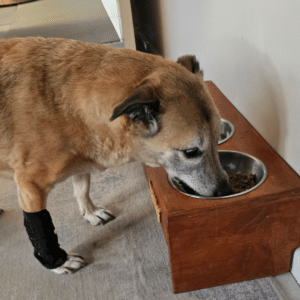
She has a pentosan injection once a month, which keeps the joint fluid healthy and reduces inflammation. She takes daily pain medication to keep her comfortable. She’s on ongoing mobility supplements. She walks with me almost every day, with her brace on her front right paw to keep that joint stable, and she is, at 14, still one of the most joyful dogs I have ever known.
I’m not going to pretend arthritis is nothing. It isn’t. But I also know from watching Emmy that a diagnosis of arthritis is not the end of the road. It’s the beginning of a different kind of care.
If your dog has just been diagnosed, or you’re noticing signs you’re not sure about, this post is for you.
What Arthritis Actually Is
Arthritis, or more precisely osteoarthritis (OA), is the progressive degeneration of cartilage within a joint. Cartilage is the smooth, slippery tissue that allows joint surfaces to glide over each other without friction. When it breaks down, the bones begin to rub together. The body responds with inflammation, new bone growth around the joint margins (called osteophytes or bone spurs), and thickening of the joint capsule. The result is pain, stiffness, and reduced range of motion.
It’s a one-way process. The cartilage doesn’t regenerate. What you’re managing with treatment is the rate of progression and the level of discomfort, not a cure.
What causes it?
Arthritis in dogs usually develops for one of three reasons.
As a primary condition in older dogs. Just as in people, joints wear over time. The cumulative effect of years of movement, impact, and daily use eventually degrades the cartilage. This is the “wear and tear” arthritis most people think of.
As a secondary condition following joint disease or injury. If a dog has had cruciate surgery, hip dysplasia, IVDD, a fracture, or any significant joint injury, arthritis in that joint is a very likely long-term consequence. Emmy’s arthritis is this type: the two surgeries changed the mechanics of her knees permanently, and the arthritis followed.
As a result of obesity or chronic joint overload. Joints that have been carrying excess weight for years, or absorbing high-impact forces repeatedly, degrade faster. A dog who has been jumping off beds and car boots for a decade is loading their joints differently from one who hasn’t.
How to Recognise Arthritis in Your Dog
The challenge with arthritis is that dogs don’t tell you they’re in pain. They adapt, compensate, and carry on with remarkable stoicism. By the time something is visibly wrong, the condition is often well advanced.
Early signs
Stiffness when getting up from rest, particularly in the morning or after a long lie-down, which improves once they’ve been moving for a few minutes. A subtle reluctance to do things they used to enjoy, like jumping into the car, climbing onto the bed, or going up stairs. Slightly slower pace on walks. Occasional licking or attention to a specific joint.
More pronounced signs
Visible lameness or limping, which may shift between legs. Difficulty rising at all without a struggle. Muscle wasting around affected joints as the dog begins to shift weight away from painful areas. Irritability, particularly if touched around the affected joint. Sleeping more, engaging less.
What to look for in specific joints
Hips: difficulty with the back end, bunny-hopping gait, reluctance to jump. Elbows/shoulders: front-leg stiffness, holding a leg up after rest. Knees (stifle): stiffness through the hind leg, particularly after the dog has been lying down on a hard surface. Spine: reluctance to bend, difficulty with stairs, neck stiffness.
If you’re seeing any of these in your dog, a vet visit and some X-rays will give you a clear picture.
Managing Arthritis Well
Emmy’s management plan has evolved over the years, but the core components have remained consistent. Here’s what works.
Pain management
The most important thing you can do for an arthritic dog is manage their pain properly. Undertreated pain doesn’t just make them uncomfortable: it changes their behaviour, reduces their willingness to exercise (which actually makes arthritis worse), and affects their quality of life profoundly.
NSAIDs (non-steroidal anti-inflammatory drugs) are the most commonly prescribed first-line treatment for dogs who can safely take them. Work with your vet to find the right medication and dose for your specific dog, and monitor for side effects.
Not every dog can take NSAIDs safely. Dogs with kidney disease, like Emmy, often can’t. Her vet has her on Epleptin (gabapentin) instead, and she’s thriving on it. If NSAIDs aren’t an option for your dog, pain management isn’t off the table, your vet will have alternatives suited to your dog’s specific health picture. On days where Emmy is experiencing more pain than usual, I supplement the Epleptin with half a panado, in line with her Vet’s guidance.
Pentosan polysulfate sodium (pentosan injections)
This is what Emmy has monthly. Pentosan acts as a disease-modifying agent: it stimulates joint fluid production, supports cartilage health, and has anti-inflammatory effects. It’s not a painkiller, but it makes a real difference to joint function over time. For dogs with moderate to severe arthritis, the monthly injection is often a cornerstone of management.
Supplements
Omega-3 fatty acids (from fish oil) have good evidence behind them for reducing joint inflammation. Glucosamine and chondroitin are commonly recommended for cartilage support, with variable evidence but minimal downside. In South Africa, vets commonly recommend joint powders like GCS Joint Care or MobiFlex, sprinkled daily over food, which combine glucosamine, chondroitin and other joint-supportive ingredients in one. These work best as long-term, preventive supplements rather than acute treatments.
Weight management
If your arthritic dog is overweight, getting them to a healthy weight is arguably the single most impactful thing you can do. Vet-reviewed guidance from the American College of Veterinary Surgeons confirms weight management is a cornerstone of osteoarthritis treatment, alongside exercise and pain control, and that even modest weight reduction leads to significant improvements in mobility and pain levels in arthritic dogs.
Exercise: the counter-intuitive advice
Arthritic dogs need to keep moving. Controlled, low-impact, regular exercise maintains muscle mass around the joints, which supports stability and reduces pain. Short walks on flat surfaces, daily, are far better than occasional long bursts of activity. Swimming is excellent.
What you want to avoid is high-impact activity: jumping, running on hard surfaces, sudden direction changes. This is where ramps come in.
Why Ramps Are Particularly Important for Arthritic Dogs
Arthritis is painful enough at rest. Add the impact of repeated jumping to already inflamed, degenerated joints, and you’re dramatically accelerating both the pain and the progression.
A dog with arthritic hips that jumps in and out of a car boot twice a day is loading severely compromised joints with 300 to 500kg of impact force at each landing. Every single day. For years.
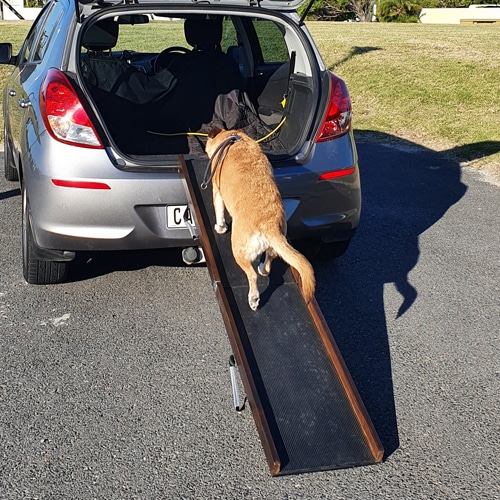
A ramp removes this completely. The dog walks down a gentle incline, loading each limb progressively and evenly, with no sudden peak force on any joint.
Beyond the car, ramps help arthritic dogs get on and off beds or couches (where that’s appropriate given their specific condition), reducing the number of high-impact moments in their day. For a dog in pain, this isn’t a nice-to-have. It’s meaningful relief.
A note on consistency
An arthritic dog still has good days and bad days. On a good day, they may feel confident enough to try to jump. This is exactly when the habit of using a ramp matters most: if the ramp is always there and always in use, the dog doesn’t have the opportunity to make a bad call on a day they’re feeling better than they should be.
Emmy still chooses her car ramp every time, for vet visits, for trips to see her ‘granny’, for walks somewhere new. She doesn’t have ramps around the rest of the house anymore. Instead, I’ve put rubber matting down everywhere she walks or likes to lie down, so she’s got proper grip underfoot, and something to push against when she gets up off the floor. It’s made a real difference, not just to stop her slipping, but so getting up isn’t a fight in itself.
Arthritis is part of Emmy’s life, but it doesn’t define it.
With the right management, it doesn’t have to define your dog’s life either.
👉 Shop the Dog Mom handcrafted ramp collection
Related reading:
- Veterinary Physiotherapy for Dogs: Rehab & Mobility
- Why Jumping Is Secretly Damaging Your Dog’s Joints
- CCL Surgery in Dogs (ACL): What Every Dog Parent Should Know
- IVDD in Dogs – What Every Dog Parent Should Know
- Dog Ramps South Africa: Handcrafted & Sturdy for All Breeds
A quick note before you go: I’m not a vet or a veterinary physiotherapist. I’m a dog mom who’s lived through a lot of this myself with Emmy, Oscar and Levi, and learned the rest from other people’s dogs and from the research I’ve done working out how to build ramps that suit very different situations. I’ve also spoken to a lot of veterinary physiotherapists over the years, and much of what’s here comes from them. If your dog is showing any of the signs above, or anything here raises a question, please see your vet or a qualified veterinary physiotherapist, they know your dog and can give you the direct answer I’m not qualified to.


