
Why Jumping Is Secretly Damaging Your Dog’s Joints

I was at daycare collecting my dogs, Oscar and Emmy, when it happened. They came bounding out to the car, Emmy’s tail going like a helicopter, beside herself with excitement, as she launched herself into the boot. Nothing unusual. She’d done it a thousand times. But that day, she ruptured her cruciate ligament.
She was mid-air when it happened, and by the time she landed she was already limping. Looking back now, I know it wasn’t that one jump that did it. That jump was just the one that pushed her past her limit. The damage had been building quietly for years.
Emmy is 14 at the time of writing this post. She’s had two cruciate ligament surgeries (one on each side) and she wears a brace on her front right paw every time we go for a walk. And I’ll be honest with you: most of the damage was preventable. I just didn’t know what I didn’t know.
That’s what this post is about.
The Physics Your Dog’s Body Has to Deal With
When your dog jumps down from a bed, couch, or the back of a car, their body has to absorb the full force of the landing. That force isn’t just their body weight; it’s their weight multiplied by the speed of the fall.
Research in veterinary biomechanics has shown that the impact force on a dog’s forelimbs during landing can be five to six times their body weight. So if your Labrador weighs 30kg, their front legs absorb up to 180kg of force with every single landing.
Now think about how often that happens in a single day. Off the bed in the morning. Down from the couch after breakfast. Out of the car boot in the afternoon. Back onto the couch in the evening. That’s easily four to six high-impact landings per day, over 1,500 times a year.
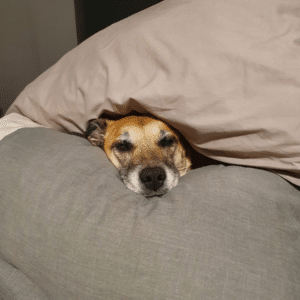
For Emmy, that was years’ worth of jumps: into and out of the car boot, on and off the couch, and up onto my bed. When visitors came over, Emmy would hear the doorbell and come to welcome them (a quick greeting, very polite) and then she’d disappear. Up onto the bed, behind the pillows, into her own little haven. She’d leave Oscar, her brother, to do the real entertaining. He was the people dog, happiest in the middle of the action, whoever was there. Emmy was perfectly happy to let him have it.
It was one of my favourite things about her. And it never once crossed my mind that every one of those jumps onto the bed, off the bed, in and out of that car boot, every single day, was adding up.
I never thought twice about any of it. Why would I? She loved it. She was good at it. She seemed completely fine.
Until she wasn’t.
Which Dogs Are Most at Risk?
While jumping affects all dogs, some are significantly more vulnerable than others.
Small and long-backed breeds
Dachshunds, Corgis, Basset Hounds, and Beagles are at high risk of Intervertebral Disc Disease (IVDD), a spinal condition where the discs between the vertebrae rupture or bulge under pressure. Repeated jumping is one of the biggest contributors to this painful, and sometimes paralysing, condition.
Large and giant breeds
German Shepherds, Labradors, Golden Retrievers, Rottweilers, and Great Danes are prone to hip dysplasia and elbow dysplasia, structural joint conditions that are worsened by repeated impact. In large breeds, the weight-to-joint-surface ratio means every landing hits harder.
Senior dogs
As dogs age, their cartilage thins and their joints lose cushioning. A 9-year-old dog jumping off the bed causes far more damage than a 2-year-old doing the same thing, even if they look completely fine doing it.
Overweight dogs
Extra body weight means extra impact force. An overweight dog jumping off a couch isn’t just risking their joints; the two problems compound each other rapidly.
Dogs recovering from surgery
If your dog has had CCL (ACL) surgery, spinal surgery, or any orthopaedic procedure, jumping is often the single biggest threat to a successful recovery. Even when they seem healed, the internal repair is still fragile.
What I learned the hard way
After Emmy’s first cruciate surgery, I built her a couch ramp, thinking that the effort of jumping up onto the couch was the issue. Her cruciate ligament had ruptured in her back legs, so in my mind, the ramp was there to take the strain out of getting UP. I wasn’t really thinking about the coming down. When she jumped straight off the couch, I wasn’t too concerned. I thought I had the problem solved. I was wrong.

Almost 100% of the time, she used the ramp beautifully to get up onto the couch. That part worked perfectly. The problem was coming down. When something exciting caught her attention and she wanted to get outside quickly, Emmy would take the path of least resistance in her mind. Instead of walking over to where the ramp was and coming down properly, she would simply jump off. The doorbell. The dog next door barking at the wall. (During lockdown, that happened constantly.) And each time she did, she was loading that front right paw with impact it was never going to recover from. Emmy now has laxity in that front right paw and has to wear a brace every time we go for a walk to keep it stable. Jumping down, as it turns out, is the bigger problem. I just didn’t know that yet.
After her second cruciate surgery (three years later, chasing a ball this time), I made a harder call. I removed the couch ramp entirely. She lost couch privileges. It wasn’t a decision I took lightly; Emmy on the couch is basically her personality. But the jumping off was doing more damage than the jumping on, and I couldn’t manage what I couldn’t see coming.
The Long-Term Consequences
The tricky thing about joint damage from jumping is that it’s cumulative and slow. You won’t see it happening, until one day you do.
Common consequences of repeated high-impact jumping include:
- Arthritis: the most common long-term outcome, caused by cartilage breakdown over time. Emmy developed arthritis as a result of her two ACL surgeries. She now goes for a monthly pentosan injection, takes daily pain medication to keep her comfortable, and is on ongoing mobility supplements. She also has physio twice a month. It is manageable, but it is also for life.
- CCL (ACL) tears: the cruciate ligament in the knee is frequently damaged by the twisting motion of landing
- IVDD: spinal disc rupture, particularly in chondrodystrophic breeds like Dachshunds
- Hip and elbow dysplasia progression: existing structural issues deteriorate faster with repeated impact
- Joint laxity: repeated impact can cause the ligaments around a joint to stretch and loosen over time, leading to instability
That last one is exactly what happened to Emmy, as I described above. The laxity had been building quietly for years before it became visible as a problem.
The cruel irony is that dogs rarely show pain until a condition is already well advanced. They are stoic by nature; they’ll keep jumping, keep playing, and keep wagging their tails right up until they can’t. Emmy was no different. She seemed absolutely fine right up until she wasn’t.
What You Can Do Right Now
The good news is that this is one of the most preventable forms of joint damage in dogs. And the solution is simpler than you’d think.
Use a ramp, and actually commit to it
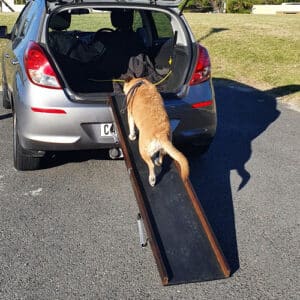
A quality dog ramp gives your dog a gentle, low-impact incline to walk up and down from elevated surfaces: the bed, the couch, the car boot, wherever they spend time. Instead of a single explosive landing that shocks their joints, they walk down a surface that distributes the load evenly across all four limbs.
After Emmy’s first cruciate surgery, her recovery period was what finally pushed me to build my first dog ramp, specifically for the car boot. That ramp was the beginning of Dog Mom. I wish I’d built it before the surgery, not after.
The important thing I’d add from experience: a ramp only protects your dog if they use it every single time. If your dog still finds ways to leap off, especially if something startles them, you may need to make the decision I did and remove access to that surface altogether, at least until their recovery is complete. A ramp you can’t consistently use isn’t protection.
Start young
Don’t wait for a rupture or a diagnosis to introduce a ramp. The time to protect your dog’s joints is before the damage starts. A puppy who grows up using a ramp will have significantly better joint health in their senior years than one who spent a decade jumping freely.
Had I known at the beginning what I know now, Emmy would have had a car ramp from the moment she was big enough to jump. She would have had a couch and bed ramp long before her first surgery. And she probably wouldn’t need the brace she wears today.
Keep their weight healthy
Every extra kilogram your dog carries multiplies the impact force on their joints. Keeping your dog lean is one of the most powerful joint-protection strategies available, and it costs nothing.
Know your breed’s risks
If you have a breed that’s genetically predisposed to back or joint problems, be even more vigilant. Prevention is always cheaper, financially and emotionally, than treatment.
A Ramp Isn’t a Compromise. It’s a Gift.
Emmy is 14 and still going, brace and all. She’s one of the toughest, most joyful dogs I’ve ever known. But I’d give a lot to go back and give her a ramp on day one. Not because it would have guaranteed a perfect outcome, but because it would have given her joints every possible advantage.
You may still have that chance with your dog.
👉 Shop the Dog Mom handcrafted ramp collection
Related reading:
- Arthritis in Dogs: Signs, Management and Ramp Tips
- CCL Surgery in Dogs (ACL): What Every Dog Parent Should Know
- IVDD in Dogs – What Every Dog Parent Should Know
- Why Big Dogs Need Ramps Just as Much as Small Dogs
- Dog Ramps South Africa: Handcrafted & Sturdy for All Breeds
A quick note before you go: I’m not a vet or a veterinary physiotherapist. I’m a dog mom who’s lived through a lot of this myself with Emmy, Oscar and Levi, and learned the rest from other people’s dogs and from the research I’ve done working out how to build ramps that suit very different situations. I’ve also spoken to a lot of veterinary physiotherapists over the years, and much of what’s here comes from them. If your dog is showing any of the signs above, or anything here raises a question, please see your vet or a qualified veterinary physiotherapist, they know your dog and can give you the direct answer I’m not qualified to.


